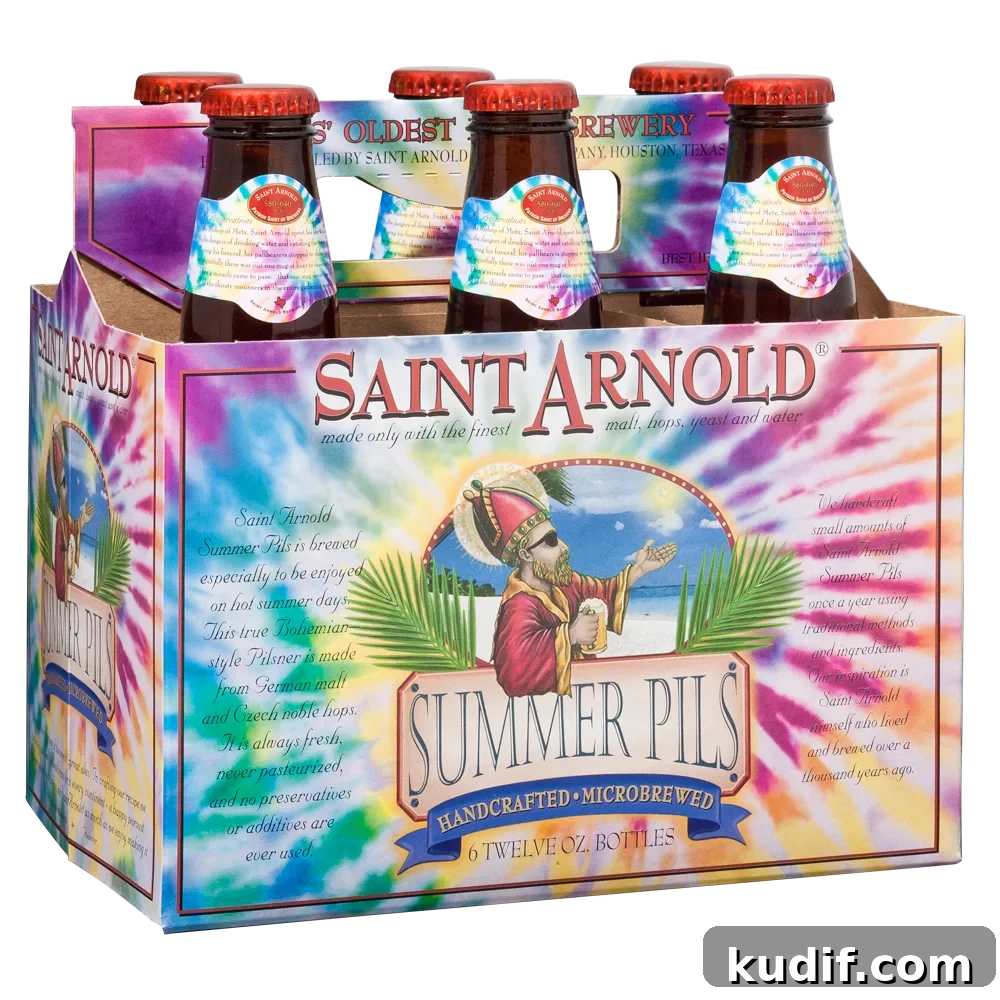
Saint Arnold Brewery Summer Pils (Picture Courtesy of Saint Arnold Brewery)
I don’t subscribe to Men’s Journal and rarely visit their site, but a few weeks ago I spotted an issue on a flight with a feature titled The 24 Best Beers in America. I picked up the discarded copy at the end of the flight to read the piece. The layout was glossy and attractive, grouping the top 24 beers into categories such as Pilsner, Wheat, Lager, Pale Ale, IPA, Brown Ale, Belgian-style Ale, and Porter/Stout. Still, the selections surprised me—both for who made the list and for how many breweries I’d never heard of.
What surprised me most were some mainstream choices labeled the “best” in class: lagers from Samuel Adams and Yuengling, and Sierra Nevada’s Pale Ale. Beyond those, the only beers I recognized were Boulevard’s Unfiltered Wheat and New Belgium’s Ranger IPA. In short, I had only tried or knew 5 out of the 24 beers mentioned—hardly a definitive measure of my beer expertise.
That led me to wonder: can anyone realistically determine the single best beer in the United States? According to the Brewers Association in 2011, there were nearly 2,000 operating breweries in the country, and 97% of them were classified as brewpubs, microbreweries, or regional craft breweries. That breadth is a great sign for the beer industry, but it also makes naming a definitive “best” beer an enormous, if not impossible, undertaking.
Fortunately for lovers of good beer, the diversity is a blessing. Beyond the eight categories Men’s Journal used, competitions like the United States Open Beer Championship evaluate dozens more styles—there were roughly 50 additional styles judged in 2012—giving drinkers plenty to explore.
Yuengling Brewery Traditional Lager
I’m a strong supporter of local businesses, and that includes craft breweries. I do so for four main reasons. First, freshness matters—a local brewery’s products are often much fresher than widely distributed alternatives. Second, smaller brewers can be nimble and experimental, taking creative risks to develop new beers and letting the local market determine success. Third, local brewers tend to know their customers and offer a rotating selection to match seasonal and regional tastes. Finally, supporting local talent bolsters the local economy and rewards entrepreneurs who risk time and capital to pursue their craft.
At the end of the day, choosing the “best” beer is personal. I gravitate toward pilsners and lagers, and I prefer draft when possible. Over recent years I’ve enjoyed several pilsners and lagers that have stood out as particularly memorable:
- New Belgium Blue Paddle Pilsner Lager – I’ve had it before but haven’t seen it on shelves lately.
- Saint Arnold Brewery Summer Pils – happily, it’s being offered again this year.
- Samuel Adams Noble Pils – reportedly returning this year.
- Spoetzl Brewery Shiner 101 – a discontinued, limited-edition release.
- Yuengling Traditional Lager – not currently available in my area (Texas).
Shiner 101 Czech Style Pilsner (Picture Courtesy of the Spoetzl Brewery & McGarrah Jessee)
No doubt there are exceptional pilsners and lagers across the country that would top my list if I’d had the chance to try them. With nearly 2,000 breweries nationwide and only a fraction of those beers distributed to Houston, I can only sample what my travels and local retailers offer. The variety and quality available, though, make discovering new favorites an ongoing pleasure.
Sources that inspired this piece include Men’s Journal’s compilation of top beers, Brewers Association brewery statistics, and results from the United States Open Beer Championship. I also appreciate the teams at Saint Arnold Brewery and Spoetzl Brewery for providing authorized images used here.